
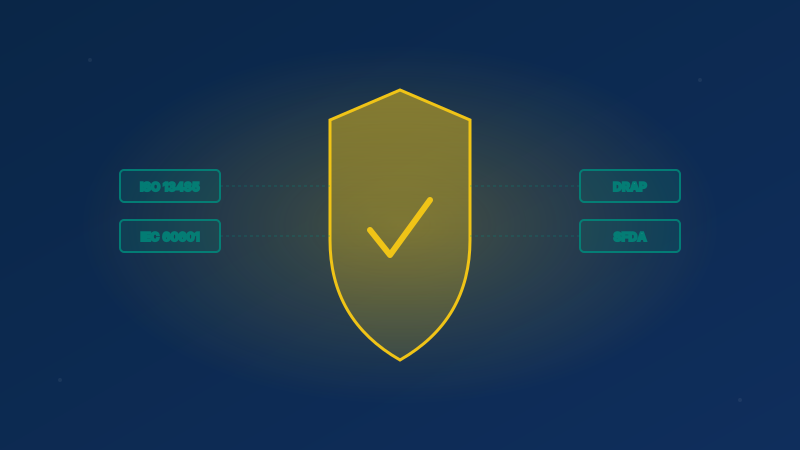
Hospital procurement teams hear "ISO 13485" and "IEC 60601" constantly, often used interchangeably and almost always misused. Here is what each one actually means, what it requires, and why a vendor claim of one without the other is meaningless.
ISO 13485 — Medical device quality management
ISO 13485 is a quality management system standard. It does not test equipment. It does not certify performance. It tests the process by which a manufacturer or refurbisher produces medical devices.
A company holding an ISO 13485 certificate has demonstrated that: - They document procedures. - They track corrective actions. - They maintain traceability records. - They review processes periodically.
What ISO 13485 does not prove: - That any specific device works. - That any specific device is electrically safe. - That any specific device performs to manufacturer specification.
ISO 13485 is necessary infrastructure for a serious medical-device organization. Buying from an ISO 13485-certified vendor reduces the chance of poor process. It does not, by itself, prove the unit you are buying is safe and functional.
IEC 60601-1 — Medical electrical equipment safety
IEC 60601-1 is a per-device electrical safety standard. It tests the actual unit. The specific tests include: - Earth leakage current — current flowing to ground under normal conditions. - Patient leakage current — current that could flow through a patient connected to applied parts. - Touch / enclosure leakage — current accessible at the device housing. - Ground continuity — resistance between protective earth and accessible metal parts. - Dielectric strength (hipot) — withstand voltage applied between live parts and ground.
IEC 60601-1 testing produces a per-unit pass/fail with measured values. It is the test that matters when an electrosurgical generator, anesthesia machine, or patient monitor will be plugged into a hospital wall and connected to a patient.
What IEC 60601-1 does not test: - Functional performance (an electrically safe unit can still be functionally broken). - Calibration accuracy. - Software behavior.
Why both matter, together
A vendor with ISO 13485 but no IEC 60601-1 testing has a quality system but cannot prove any specific unit is electrically safe.
A vendor doing IEC 60601-1 testing but no quality system has electrically-safe units but no traceability — meaning when something fails, no one can establish what happened or replicate the fix.
A serious refurbishment operation does both: ISO-aligned process plus per-unit IEC testing with documented results.
What to ask for
- The vendor's ISO 13485 certificate number and certification body. (Verify directly with the certification body if it matters.)
- A sample IEC 60601-1 electrical safety test certificate from a recent refurbishment, with measured values and a unit serial number.
- The full refurbishment record for the specific unit you intend to purchase, including pass/fail electrical safety results.
This is what genuine refurbishment looks like. Anything less is a vendor hoping you don't ask.