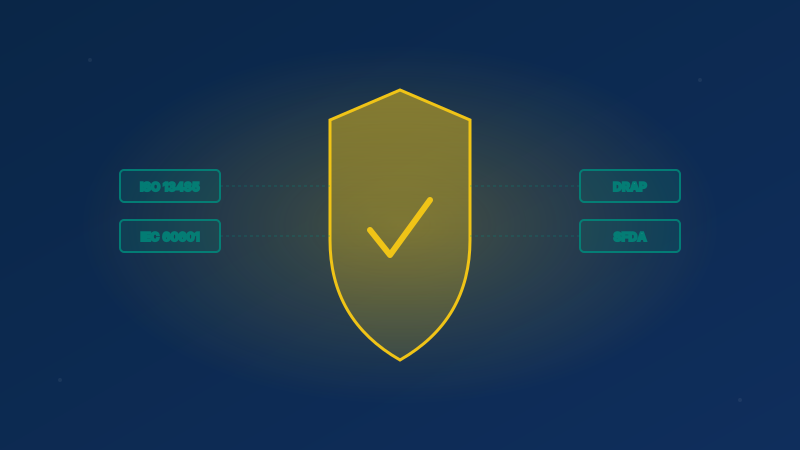
The Drug Regulatory Authority of Pakistan (DRAP) is responsible for medical device registration, importer licensing, and post-market surveillance under the Medical Devices Rules 2017 (and subsequent amendments). For Pakistani hospital procurement teams, DRAP touches every imported piece of medical equipment — sometimes lightly, sometimes substantively, depending on the device class.
This article is procurement-focused. It explains what DRAP requires, when it matters, and how to avoid the customs-clearance delays that haunt poorly-documented imports.
Device classification
DRAP follows a four-class system aligned broadly with international medical-device frameworks:
- Class A — low risk (basic instruments, hospital furniture, non-active devices). Lighter registration burden.
- Class B — low-to-moderate risk (most monitoring, diagnostic, and non-invasive equipment).
- Class C — moderate-to-high risk (most surgical, anaesthesia, ventilation, imaging equipment).
- Class D — high risk (implantables, life-support equipment, certain energy-delivery devices).
Class C and Class D devices carry the most documentation burden. Most refurbished medical equipment imported by hospitals falls into Class C — surgical towers, anaesthesia machines, ventilators, imaging systems.
Who registers — manufacturer, importer, or both?
DRAP registration is held by a Pakistani-licensed importer, not by the foreign manufacturer or the hospital. Your supplier (us, or any other) coordinates with the licensed importer who holds the registration.
This means: when you buy refurbished equipment from a US/UK source through a Pakistani channel, the documentation chain is:
- Foreign refurbisher → ASQ (or another supplier) → Licensed Pakistani importer → Hospital
- The licensed importer holds the DRAP registration covering that specific device category and brand.
- Customs clearance and final delivery happen under the importer's name.
If your supplier proposes to ship equipment direct to your hospital without going through a licensed importer, that's a customs-clearance problem waiting to happen. Verify the import-of-record arrangement before payment.
Documentation that travels with the device
For Class C imports, DRAP-aware documentation typically includes:
- Manufacturer Authorisation Letter — from the foreign refurbisher / supplier, naming the Pakistani importer.
- Free Sale Certificate or equivalent — from country of origin (US, UK, EU) confirming the device is legally marketed there.
- Refurbishment certificate — for refurbished units, documenting the work performed.
- Calibration certificate — measured values vs. OEM specification.
- Electrical safety test result — IEC 60601-1 leakage and ground continuity.
- Operating manual and quick-reference materials in English (Urdu translation increasingly preferred).
ASQ produces all of the above for refurbished equipment we ship into Pakistan. Hospital procurement teams should request these documents at the time of quote — not after delivery.
Customs clearance — where things go wrong
Three common scenarios where shipments get stuck:
- HS code mismatch — the customs declaration's HS code doesn't match the device's actual category, triggering a re-classification and re-inspection.
- Importer-of-record gap — equipment arrives without a clear DRAP-registered importer named on the documentation, requiring retrospective filing.
- Documentation language — non-English documentation gets flagged for translation, often adding 2–4 weeks to clearance.
Each of these costs time, money, and storage fees. The fix in every case is upstream: comprehensive documentation produced before shipment, coordinated with a properly-licensed importer.
Post-market and surveillance
DRAP-registered devices are subject to post-market surveillance — adverse-event reporting, recall notices, and periodic re-registration. For hospital procurement teams, this means:
- Keep refurbishment certificates and calibration records on file.
- Maintain a service log per device.
- Flag any adverse events through the importer to DRAP.
- Track re-registration cycles for long-life equipment.
A maintained service log is the single most useful document during DRAP audits, post-market events, and equipment-transfer scenarios. Our [maintenance contracts](/services/maintenance) include service-history archive maintenance for exactly this reason.
Engaging us
ASQ Consultancy works alongside DRAP-licensed importer partners for every Pakistani delivery. The documentation flow is part of the standard quote we provide — including DRAP-relevant paperwork bundled with refurbishment, calibration, and electrical-safety certificates. Send an inquiry through our [contact form](/contact) for a sample documentation package on a representative device.